
The terms advice, guidance, and counselling are often used interchangeably within the Health and Social Care sector. They represent significantly distinct approaches in terms of execution and processing, and depending on your requirements, it really is beneficial to seek clarity beforehand prior to undertaking either step.
They all contribute significantly to assisting people in overcoming obstacles in life, but they deal with different facets of those obstacles. People get advice & guidance when they feel powerless or wish to avoid making significant changes. Getting advice & guidance is far simpler than going through the frequently unpleasant process of self-evaluation and transformation in counselling. This blog examines the differences between advice and guidance and counselling, providing clear explanations of how they assist individuals in making decisions, managing life’s challenges, and understanding the circumstances under which each approach is most suitable.
What is Advice & Guidance?
Advice and guidance is essentially the method through which one is helped to make decisions that are smart and informed in one’s own life, notably in the areas of education, career, and vocations. The tool is recognised as a means to support decision, making whereby individuals are given the necessary information and direction if they are to move forward.
Key Characteristics
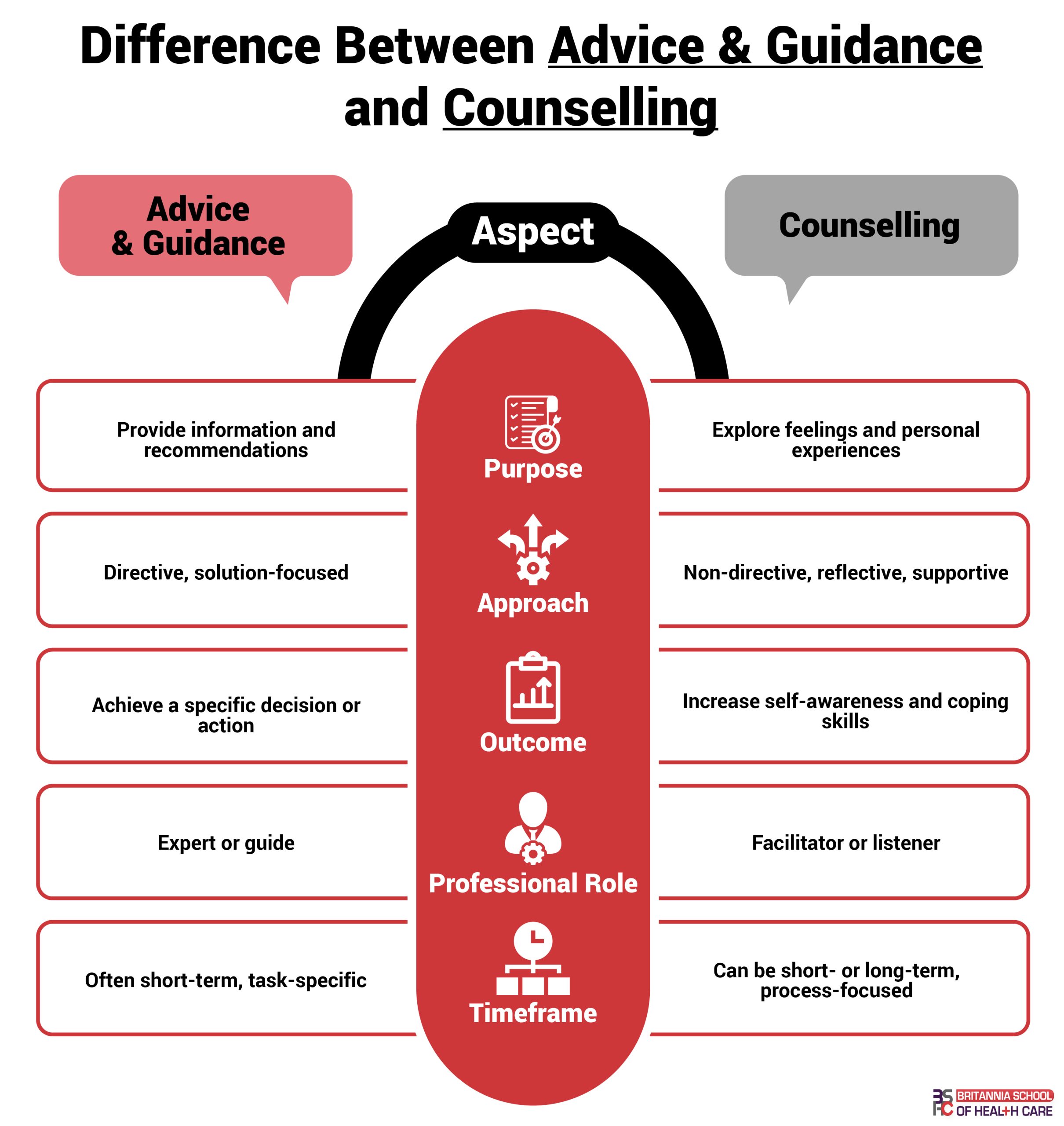
- Directive approach: The professional shares expertise and recommendations.
- Focused on solutions: The goal is to help the individual make a specific decision.
- Short-term and task-specific: Usually limited to the time needed to provide guidance.
Examples:
- Career advisor supporting a student to pick the college courses that match their interests.
- Financial advisor explaining to a client the different investment options in which they can put their money.
- A health professional offering advice on diet or lifestyle changes.
The key here is that the professional shares expertise and suggestions, allowing the individual to make a decision based on their circumstances. The professional’s role is directive but supportive, and the interaction usually focuses on achieving a specific outcome.
Understanding Counselling
In contrast, counselling is focused on the process and is an exploration. Through counselling, a person gets a safe and non, judgmental place to analyse his/her feelings, thoughts, and behaviours. Counselling is a deeper level of understanding and growth of the person, rather than providing answers or giving advice.
Key Characteristics
- Non-directive approach: The counsellor listens and encourages reflection.
- Focus on feelings and understanding: The goal is personal growth.
- Flexible timeframe: Sessions can be short- or long-term, depending on needs.
Examples:
- A counsellor facilitating the grieving process or anxiety reduction in a person.
- Helping a client to identify the causes that lead to relationship issues.
- Working with a person so that he/she can develop the necessary emotional strength to face difficult situations.
Here, the professional’s role is non-directive, listening actively, asking open questions, and guiding reflection. The focus is on helping the individual gain insight, clarity, and self-awareness so they can make their own decisions.
Why the Distinction Matters
Mixing up the two can have significant effects on results. Advising a person who is in need of counselling might be perceived as an intervention with which the person does not agree or as something that does not help the person, on the other hand, if you give counselling to a person who is looking for guidance, this person may end up feeling that he/she is not supported or that he/she is irritated. Experts have to evaluate the person’s needs thoroughly to decide which method would be suitable.
What is the relationship between advice & guidance and counselling?
Advice & guidance and counselling have a supportive relationship as both focus on helping individuals dealing with problems, making decisions, and going ahead in their lives. Counselling helps clients to delve into their feelings, thoughts, and emotional experiences in a secure and non, judgemental setting. It aids self, awareness, emotional release, and personal insight. Advice and guidance, on the other hand, are more direct and less complex, leading individuals to understand their options, make decisions, and take the necessary steps to achieve their goals.
The association between the two becomes very significant, especially in the case of intervention. Quite often people require counselling first in order to get emotional clarity and confidence before they can interact with advice and guidance in a meaningful way. To illustrate, a person affected by anxiety over changing a career might find it difficult to take in information or make decisions until their deep, seated fears and doubts are dealt with through counselling.
After emotional readiness has been achieved, advice and guidance may then be used to give support, provide direction, and offer practical information, such as educational routes, job opportunities, or services for the disabled. Thus, counselling is the process through which the client is internally equipped, while advice and guidance are there to help the client externally.
Why Understanding the Difference Matters
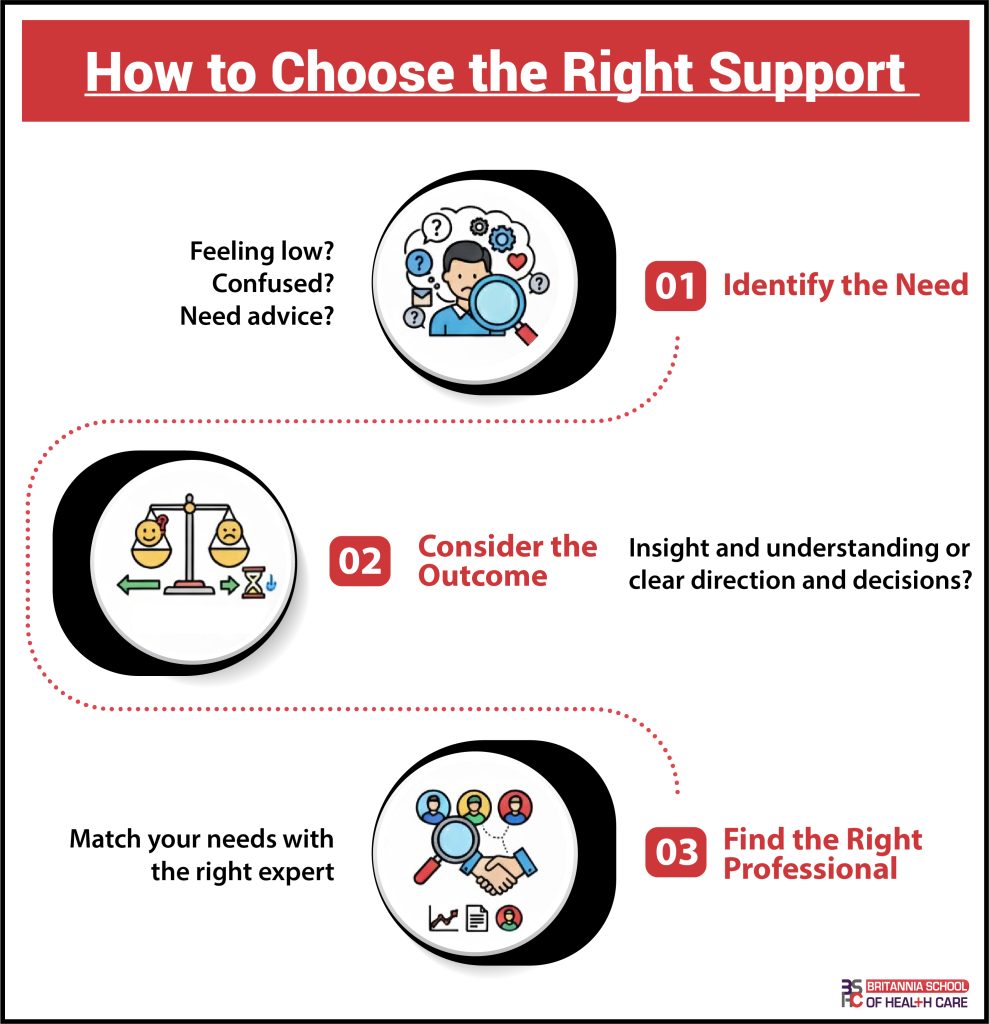
Being aware of the difference helps to make sure that people get the kind of help that is most suitable for them and at the proper time:
- Suggesting what to do to a person who really needs to be listened to might be a way in which the person feels that his/her problem is not taken seriously or that s/he is being forced.
- If you give someone counselling who is just asking for a bit of advice, then that person might end up feeling lost or that nobody is there to support him/her.
The decision on the right way to be taken should be made by the professionals after a thorough examination of the individual’s needs.
Are Counsellors Allowed to Give Advice?
The straight answer is No. Cousellors are not allowed to give advice in any circumstances. In a professional counselling setting, it is usually implied that counsellors should not provide direct advice, and in many situations, such an action is regarded as improper. The reason for this is that counselling operates on ideals like the client’s freedom, non, directiveness, and the client’s becoming stronger. Nevertheless, the response is not just a yes or no. The suitability of advice hinges upon the context, limits, and morally correct practice.
Key Insights:
- Typically, counsellors refrain from providing direct advice
- Essentially, it is their job to guide the client through self, exploration and comprehension
- If any advice is given, it may simply be sharing information or giving support in a safe situation
- Good practice from an ethical point of view necessitates the presence of definite limits and the use of professional judgement
Such a separation is what makes counselling a secure, liberating environment, helping people to discover their own way instead of being given instructions.
Final Thoughts
Both advice and guidance, as well as counselling, though related concepts, provide people with valuable support; however, they are rooted in essentially different philosophies and serve distinct objectives. Advice and guidance involve obtaining responses and directions, typically from an individual regarded as an authority or expert in the relevant field. Counselling is a process of thoroughly exploring one’s inner self to gain understanding and discover solutions independently, with the guidance of a qualified professional. Understanding these distinctions allows you to determine which form of support is most appropriate and effective for your needs, ensuring you receive the assistance that is truly necessary.