

Carers in the field of Health Care often experience mental health problems at some point in their careers. While it’s a rewarding job, being a carer can be draining on an individual with regard to emotional welfare. Most of the times, carers focus their attention on service users without recognising and remembering that their emotional wellbeing is, perhaps, equally important.
It has been estimated that approximately 40–50% of care workers have reported experiencing psychological distress and mental health concerns in comparison to the general population. Often, irrespective of age, physical health, or even psychological state, the mental distress of caregiving brings about feelings of being exhausted. There is an unseen cost in emotional and psychological strain when a person provides care, protection, and stability to another. Counselling can be incredibly effective in enabling carers to deal with stress and build their resilience, so that they can continue to offer caring with compassion.
This blog explores the importance of carers’ mental health and how counselling can offer a critical lifeline.
The Invisible Weight: Understanding the Carer’s Reality
The journey of a carer is a loving one, however, it is also filled with different kinds of challenges that are tough and non-stop. In order to understand it better, it is useful to present the main supporting principles as the 5C’s of Mental Health for Carers:
- Connection: Fighting the extreme loneliness that caregiving may bring.
- Compassion: For the loved one and, very importantly, for themselves as well.
- Competence: Being able to provide care due to having the right skills and knowledge.
- Coping: Using well-being strategies to deal with the stress, instead of just “getting through it.”
- Control: Having the feeling of power and being able to make a choice among their situation.
When these 5C’s are taken away from a carer, their well-being declines.
What is the Care Triangle for Mental Health?
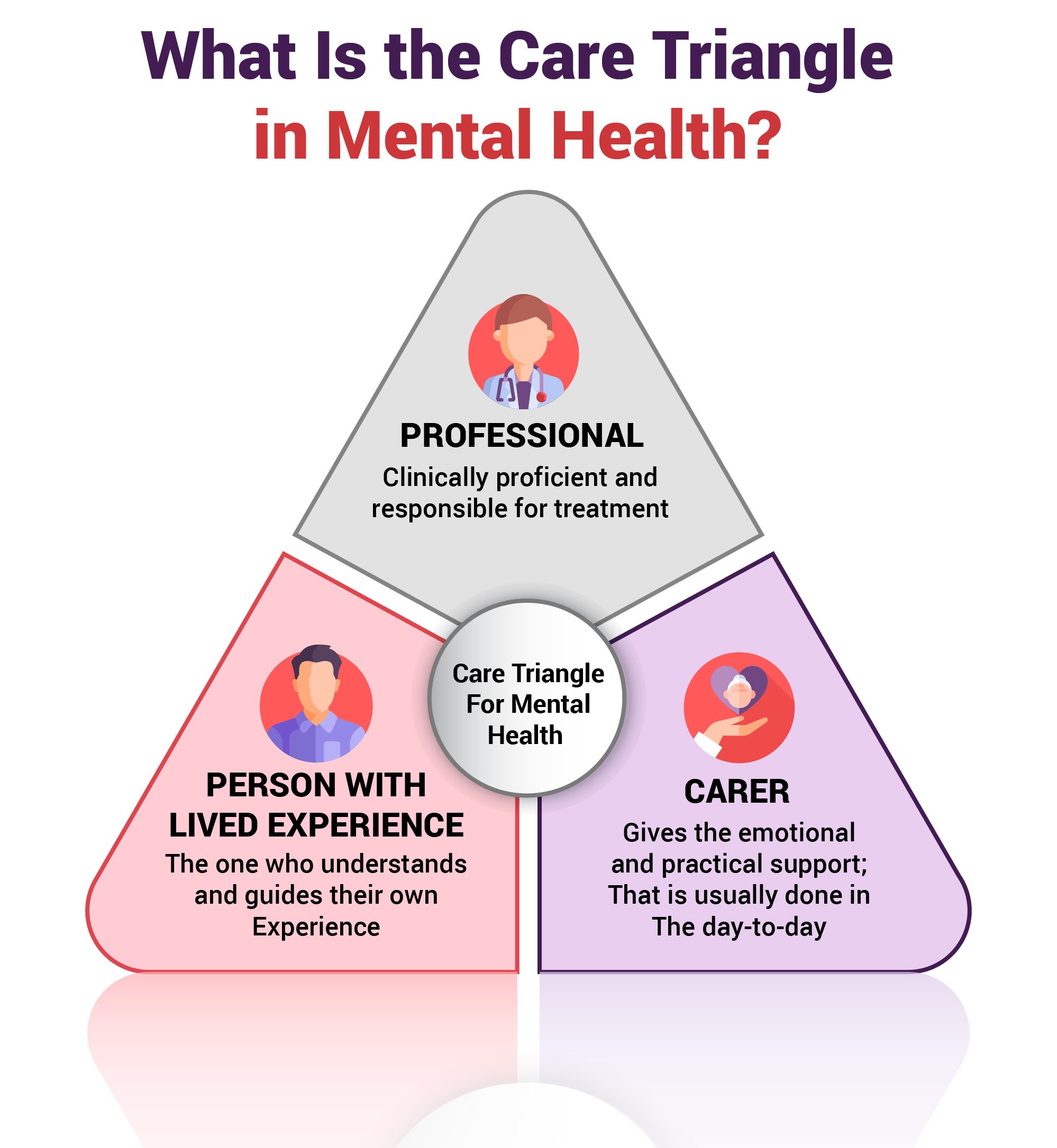
Caring is seen to impact emotional and mental health, and is viewed as a predictor of poor mental wellbeing. This reality is shaped by their position within the Care Triangle for Mental Health. This model defines the three interconnected relationships that should remain balanced for the most effective care:
- The Professional (Therapist or Doctor): Clinically proficient and responsible for treatment.
- The Person with Lived Experience (Client): The one who understands and guides their own experience.
- The Carer (Family or Friend): Gives the emotional and practical support that is usually done in the day-to-day.
The carer is the vital connection, the one who often explains between the professional and the dear one, gives the most necessary support, and is the one who implements the care plans at home. When this triangle is weak or communication is not functioning well, the whole support structure becomes unstable and the carer is the one who gets most of the pressure.
What are the 5 Impacts Experienced by Carers?
Within the healthcare industry, the implications of deteriorating mental health among workers have never been more concerning. The State of Caring 2024 survey found that growing numbers of unpaid carers are suffering from poor mental health due to not being able to take a break from their caring. Living under persistent strain can lead to a variety of mental health problems for carers, including:
The combined effect of these pressures is most apparent in the following ways:
- Physical Burnout: The symptoms of chronic fatigue, sleep disorders, and a weakened immune system that result from the continuous stress are among these manifestations.
- Social Withdrawal: The necessities of care and the stigma that is sometimes associated with mental illness can cause loneliness and a decrease in the number of one’s friendships.
- Financial Strain: The decision to reduce work hours or quit a job in order to provide care usually results in financial difficulties and worries about the future.
- Identity Erosion: The “carer” label can become the one that dominates the others – spouse, parent, employee, friend thus leading to the loss of self.
- Mental Health Decline: Carers, as a group, are more likely to suffer from anxiety, depression, and other mental health conditions.
Understanding these consequences is not about giving them our pity. It is rather an acknowledgement that it is time for prevention. Carers should be given the necessary, well-planned, and continuous support to be able to maintain their own health.
Why ‘Just Coping’ Isn’t Enough
Quite a few carers choose to carry on with their work “grinning and bearing it”, thinking that if they ask for help it means that they are weak. The truth is that help-seeking is the furthest thing from a weakness.
Counselling provides carers with an appropriate setting where they can explore experiences, feelings, and difficulties without any judgment. It is not about “fixing” them; it’s about empowering them with tools and understanding.
Counselling: A Lifeline for Carers
Focusing on the carer’s mental health is definitely not an act of neglect or selfishness. It is a wise decision that makes the caring journey sustainable. Counselling is what keeps the carer safe from burnout. It is the tool which brings back the 5C’s of mental health.
Counselling Approaches That May Prove Beneficial:
🪑🪑 Personalised Counselling: Tailored one-on-one therapy designed to meet the specific needs of the carer.
🤝 Peer Support Groups: The chance to talk over experiences with others who have the same understanding.
📞 Online or telephone Counselling: Flexible and accessible therapy with essential considerations for carers with constrained time or mobility.
Caring for Carers: Prioritising Mental Health and Wellbeing
Offering support to sustain the mental well-being of carers is a vital requirement for the proper functioning of our society. Acknowledging the profound impact of a carer role is the first step. Taking action to support the mental health of carers through counselling, community support, and systemic change is the necessary second step.
If you are a carer, please hear this: you are doing one of the hardest jobs in the world. Your love is a powerful force, but you are human. Your feelings are valid. Your exhaustion is real. Your need for support is essential.
‘’Asking for help is not a failure. It is a profound act of strength for yourself, and for the person you love so deeply. You matter too. It’s time we all started acting like it.’’